Introduction to Renaissance Painting
Renaissance painting marks one of the most transformative periods in art history, spanning roughly from the 14th to the 17th century. Emerging in Italy, this era signaled a rebirth of classical learning and wisdom after the Middle Ages, laying the foundation for modern Western art. Renaissance painting reflects a renewed interest in humanism, the study of anatomy, and naturalism—the accurate depiction of the human form and the surrounding world—which distinguished it from the more symbolic and stylized artworks of the medieval period.
The historical background of Renaissance painting is tied to the social and intellectual revival occurring across Europe during this time. Artists drew inspiration from the rediscovery of ancient Greek and Roman texts, which influenced their techniques and thematic choices. This period saw the development of innovative methods such as linear perspective, chiaroscuro (the use of light and shadow), and sfumato (the blending of colors), all of which contributed to creating more realistic and emotionally engaging images. These technical advancements helped paintings become more than decorative art—they turned into sophisticated expressions of human experience.
Renaissance painting holds a central place in the broader narrative of art history because it represents a pivotal shift towards realism and individual expression. It is a bridge between the symbolic medieval art and the modern emphasis on personal interpretation and scientific observation. The movement produced some of the greatest masterpieces and artists in history, like Leonardo da Vinci, Michelangelo, and Raphael, whose works continue to influence contemporary art and culture worldwide.
Understanding Renaissance painting provides valuable insight into the evolution of Western art, where artistic innovation met cultural and philosophical change. This introduction to Renaissance painting highlights its importance not only as a style or period but as a cornerstone of art history, shaping how art is viewed and created even today.
Historical Context and Origins
The origins of Renaissance painting trace back to a period of profound transformation known as the cultural rebirth, which began in Italy during the late 14th century. This era marked a significant shift in art history timeline as society moved away from the medieval Gothic style toward a renewed interest in classical antiquity and humanism. Renaissance painting emerged from this vibrant cultural revival, influenced by the rediscovery of ancient Greek and Roman art, literature, and philosophy.
The driving forces behind this artistic awakening were multifaceted. The economic prosperity of city-states like Florence and Venice fostered an environment conducive to patronage and artistic experimentation. Wealthy families, such as the Medici, supported artists who sought to depict the human form with unprecedented accuracy and expressiveness. Furthermore, advancements in scientific understanding and techniques, including the development of linear perspective, allowed painters to create more realistic and three-dimensional compositions.
In essence, Renaissance painting was the product of a convergence between historical circumstances and cultural aspirations. The art history timeline during this period reveals a deliberate break from the rigid conventions of the Middle Ages, embracing instead an idealized representation of nature and humanity. This cultural rebirth set the stage for some of the most celebrated masterpieces in Western art, defining the aesthetic and thematic values that would influence generations of artists to come.
Key Characteristics of Renaissance Art
Renaissance painting is distinguished by several defining Renaissance features that set it apart from earlier artistic styles. One of the most notable art characteristics is realism. Artists during the Renaissance focused on creating lifelike human figures and natural landscapes, emphasizing accurate anatomy and proportion. This pursuit of realism gave their works a vivid sense of life and presence.
Perspective is another fundamental style and technique that emerged prominently during the Renaissance era. Artists developed linear perspective to create the illusion of depth and three-dimensional space on a flat surface. This technique allowed paintings to have a more realistic spatial arrangement, drawing viewers into the scene and creating a more immersive experience.
The use of light also plays a crucial role in Renaissance painting. Artists mastered techniques such as chiaroscuro, the contrast between light and shadow, to add volume and dimension to figures and objects. This careful manipulation of light helped to enhance the realism and emotional impact of the artworks, adding drama and a sense of naturalism.
Overall, the distinctive Renaissance features of realism, perspective, and sophisticated use of light collectively define the period’s art characteristics. These innovations transformed painting into a refined art form that balances technical skill with expressive beauty, marking a pivotal shift in the history of Western art.
Famous Renaissance Painters and Their Techniques
The Renaissance period marked a revolutionary era in the history of art, characterized by innovative techniques and the emergence of famous painters whose works have influenced generations. Among the most renowned figures of this time are Leonardo da Vinci and Michelangelo, both celebrated not only for their artistic genius but also for their unique approaches to painting that exemplify Renaissance techniques.
Leonardo da Vinci is often hailed as the quintessential Renaissance man. His painting techniques were groundbreaking, particularly his use of sfumato—a method of blending colors and tones to create soft transitions between light and shadow. This technique gave his paintings a lifelike quality, enhancing depth and realism. Leonardo’s major contributions include masterpieces such as the “Mona Lisa” and “The Last Supper,” which showcase his mastery of anatomy, perspective, and emotional expression.
Michelangelo, while primarily known for his sculpture and architecture, was also a formidable painter who contributed significantly to Renaissance art. His work on the Sistine Chapel ceiling is a monumental achievement that demonstrates his profound understanding of human anatomy and composition. Michelangelo’s technique involved dynamic poses and muscular forms that brought a dramatic intensity to his paintings. Unlike Leonardo, Michelangelo’s style emphasized bold outlines and strong contrasts, which enhanced the emotional power of his figures.
Other famous painters of the Renaissance also developed distinctive styles that contributed to the era’s artistic richness. For example, Raphael was renowned for his clarity of form and balanced compositions, while Titian introduced vibrant color palettes and textures that influenced later generations. Each of these artists embraced the core Renaissance techniques of perspective, chiaroscuro (the interplay of light and shadow), and naturalism to create works that celebrated human beauty and intellectual achievement.
In summary, the Renaissance was shaped by famous painters who not only perfected existing techniques but also innovated new ones. Leonardo da Vinci’s sfumato and Michelangelo’s robust anatomical precision exemplify the era’s artistic breakthroughs. Their contributions, along with those of their contemporaries, laid the foundation for modern Western art and continue to captivate viewers worldwide.
Leonardo da Vinci’s Contributions
Leonardo da Vinci stands as one of the most influential figures in Renaissance painting, renowned for his innovative techniques and timeless masterpieces. Among his signature techniques is sfumato, a method of blending colors and tones so subtly that there are no harsh outlines, creating a smoky, soft transition between light and shadow. This technique lends his paintings a remarkably lifelike and three-dimensional quality, setting them apart from many contemporaries.
The use of sfumato is prominently showcased in one of da Vinci’s most famous works, the Mona Lisa. The delicate graduations of light and shadow in her face and hands exemplify this approach, giving her an enigmatic expression that has fascinated viewers for centuries. This nuanced shading adds depth and realism, enveloping the subject in a natural atmospheric effect.
Another Renaissance masterpiece by da Vinci is The Last Supper, an epic mural that captures the emotional intensity of the moment Jesus announces his betrayal. His keen observation of human emotion combined with precise composition marks a significant advance in narrative painting. Da Vinci’s mastery of perspective in this work draws the viewer’s eye toward the central figure, enhancing the dramatic effect.
Leonardo da Vinci’s contributions to Renaissance painting extend beyond aesthetic appeal; his innovative techniques like sfumato and his insightful portrayal of the human psyche continue to inspire artists and art lovers alike, solidifying his legacy as a seminal figure in art history.
Michelangelo and His Artistic Style
Michelangelo’s artistic style is a defining hallmark of the Renaissance, showcasing his unparalleled skill in both sculpture and painting. His approach was deeply rooted in a profound understanding of the human anatomy, which he masterfully conveyed through dynamic and realistic forms. Unlike many of his contemporaries, Michelangelo’s Renaissance sculpture emphasized muscularity and emotion, capturing the vitality and inner tension of his subjects. This is evident in masterpieces such as “David,” where the intricate detailing of muscles and veins reveals a blend of ideal beauty and naturalism.
When it came to his painting style, Michelangelo demonstrated a unique blend of grandeur and spiritual intensity, most famously seen in the Sistine Chapel ceiling. His fresco technique combined vibrant colors with dramatic compositions, highlighting both the physicality and the divine essence of his figures. Michelangelo approached painting not just as decoration but as a powerful narrative tool, capable of conveying complex theological themes with emotional depth and clarity.
Overall, Michelangelo’s artistic style is characterized by a seamless integration of sculpture and painting principles, where the physical form supports emotional expression. His works continue to inspire admiration for their technical mastery and profound impact on the Renaissance artistic tradition, making him one of history’s most revered artists.
Essential Techniques and Materials in Renaissance Painting
Renaissance painting is renowned for its revolutionary techniques and the sophisticated use of materials that gave birth to some of the most iconic artworks in history. Central to this artistic evolution was the transition from tempera to oil painting, which allowed for greater depth, richer colors, and more intricate detail. Renaissance artists mastered various painting techniques, including fresco and oil painting, to bring their visions to life.
One of the most historically significant techniques in Renaissance art was fresco painting, where pigments were applied onto wet lime plaster. This method required swift execution and precision, as the painting had to be completed before the plaster dried. Frescoes were popularly used for decorating walls and ceilings in churches and public buildings, offering durability as the pigments became an integral part of the plaster surface. Artists like Michelangelo demonstrated the grandeur and longevity achievable with this method, famously seen in the Sistine Chapel ceiling.
Despite the prominence of fresco, the late Renaissance saw a substantial shift toward oil painting. Oil paints, made by mixing pigments with drying oils such as linseed oil, provided unprecedented flexibility and vibrancy. Unlike tempera, oil paints dried slowly, enabling artists to layer colors, create subtle gradations, and add intricate details with smooth blending. This medium enhanced the ability to depict realism and texture, making it a preferred choice among masters like Leonardo da Vinci and Jan van Eyck.
The materials used by Renaissance painters were equally important as their techniques. Pigments were derived from natural minerals and organic sources, carefully ground to create vibrant and enduring colors. Canvas, wood panels, and plaster surfaces were commonly prepared with primers such as gesso to create smooth grounds for painting. Brushes varied from fine sable for detailed work to broader bristle brushes for covering larger areas, each contributing to the final effect.
In summary, Renaissance artists combined innovative painting techniques with carefully selected materials to revolutionize art. The transition to oil painting marked a pivotal advancement, offering new possibilities for expression and detail. Coupled with traditional methods like fresco, these techniques and materials form the essential foundation of Renaissance painting, influencing art for centuries.
Oil Painting and Fresco Techniques
During the Renaissance, artists perfected various art techniques that have left a lasting impact on the history of art. Among these, oil painting and fresco stand out as pivotal methods that defined the visual essence of the era. Oil painting involves pigments suspended in oil, typically linseed, which allows for rich colors, depth, and subtle gradations. This technique provided artists with the flexibility to create detailed textures and intricate effects that were not achievable with earlier mediums like tempera. It also features a slow drying time that enables blending and reworking, making it ideal for capturing realism and depth in portraiture and landscapes.
Fresco, on the other hand, is a wall painting method where pigments are applied onto wet lime plaster. As the plaster dries, the pigment becomes an integral part of the wall, resulting in durable and vibrant murals. This technique was crucial for large-scale religious and public artwork, often seen adorning churches and palaces throughout the Renaissance. Fresco demanded skilled precision and speed, as artists had to work before the plaster set. Both oil painting and fresco contributed significantly to the flourishing of Renaissance art by allowing artists to explore new ways of storytelling, light, and color, thus elevating the overall aesthetic and emotional impact of their works.
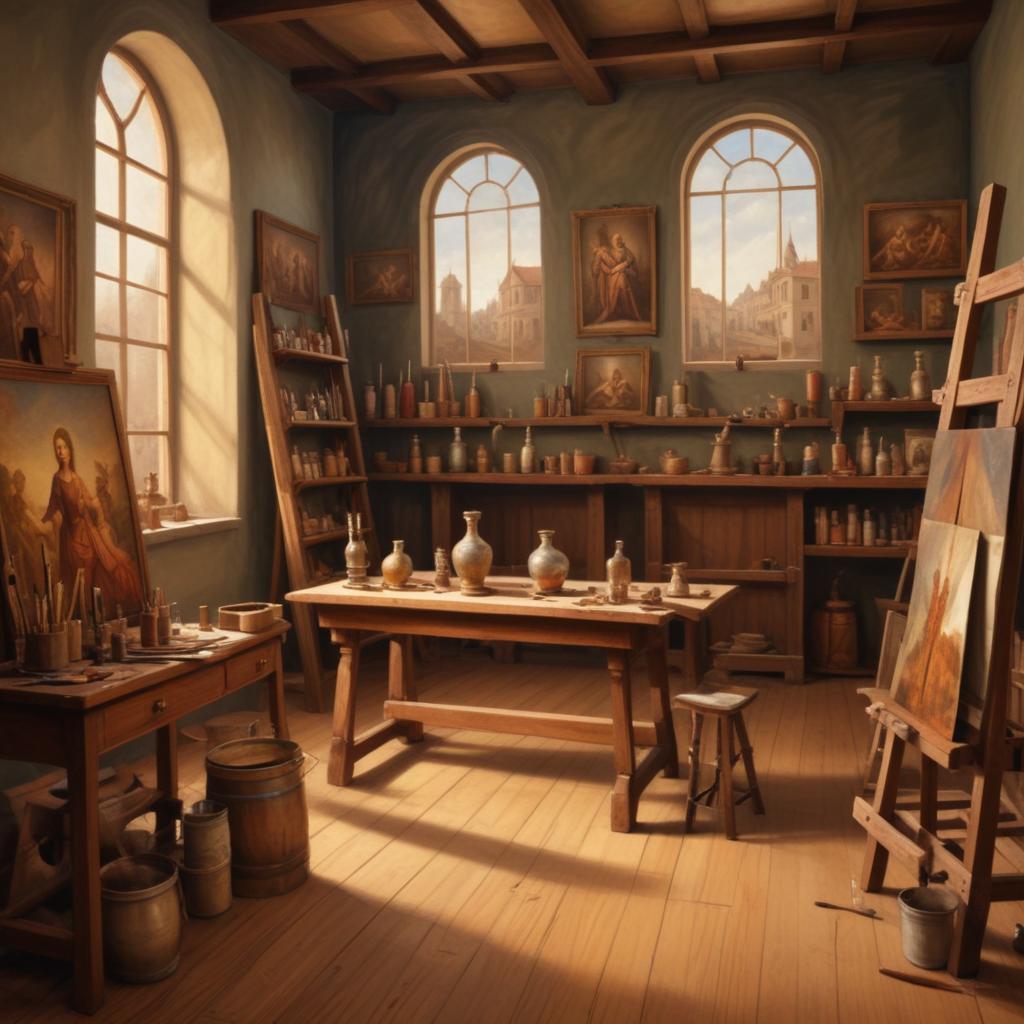
Common Materials and Tools
- Painting Materials: Renaissance painters primarily used oil paints, which were made by mixing pigments with linseed oil. This medium allowed for greater depth of color, subtle gradations, and longer working times, enabling artists to achieve more realistic effects in their work.
- Brushes: Brushes were crafted from natural animal hairs like hog bristle or squirrel hair. The variety in brush size and texture affected the precision and texture of the paint application, allowing artists to detail fine features or create broader strokes for backgrounds.
- Pigments: Natural pigments derived from minerals, plants, and even insects were ground into powders and mixed with oil. The choice and quality of pigments influenced the vibrancy and durability of the colors in the final artwork, often giving Renaissance paintings their characteristic richness.
- Canvas: While wood panels were initially common, canvas gradually became popular due to its lighter weight and flexibility. The texture and weave of the canvas could impact the paint’s absorption and finish, adding a distinct feel to the artwork’s surface.

I have spent years transforming my home into a personal gallery, constantly hunting for unique pieces that bring walls to life. There is nothing quite like the thrill of discovering an emerging artist online and finding the perfect artwork to complement a room. I am passionate about helping others navigate the world of digital art markets to find authentic pieces that truly resonate with their style.